What is Programmatic Advertising
Programmatic advertising is a form of digital marketing that is automated by using algorithms to buy and sell online advertisements. Delivering those purchased ads to the right audience relies on audience data. Data providers, like Webbula, use different platforms as resellers to sell audience data. Buyers, usually brands, purchase the audience data most relevant for their product or service from these resellers and place ads on publishers and streaming services frequented by their targeted buyers.
This process used to be completed manually and involved requests for proposals, quotes, negotiations, and manual insertion orders. Now, due to the technology involved, the entire process happens in less than a second across many different platforms.
What are the Benefits of Programmatic Advertising?
1. Target buyers on a granular level
Programmatic advertising offers vast amounts of data and insight to marketers. With all of this information about your target audiences at your disposal, you can get the right message in front of the right people, in the right place, and at the right time.
2. Access to real-time measurement and optimization
Performance is measured in real-time, and real-time measurement empowers marketers with the information needed to test and optimize programmatic ad spending and messaging. This means campaigns, with the right data analysis, can be running at optimal levels and generate ROI far more quickly than other types of marketing campaigns.
3. Full transparency over fees
You don’t need to rely on third-party agencies to manage your spending with programmatic advertising. Brands with in-house knowledge have complete control over their programmatic campaigns and ad spending. That said, outsourcing campaign management to a good third-party agency partner will ensure you have access to ad spend dashboards to monitor what is spent and where it is spent.
4. Access to contextual targeting
Contextual targeting, as defined by Instapage is “the practice of placing ads on web pages based on the content of those pages.” This is as simple as ads for swimsuits or suitcases in an article about traveling. This type of targeting focuses on specific keyword terms that the audience might be searching.
5. Increased reach due to omnichannel and format flexibility
Buyers consume media across various platforms and devices, such as desktop computers, tablets, and smartphones. Connecting the dots between platforms and devices is a challenge for most types of advertising. Programmatic advertising is unique in that it can reach your consumers with the right message, on the right device, at the right time.
What are the Types of Programmatic Advertising?
There are several formats of digital ad media buying options available to marketers. To understand which formats might be most beneficial to your programmatic advertising strategy, you need to have a good grasp of each type available to you.
Display
Display ads combine image, text, and a URL that links to a website where ad clickers can learn more about the product or service or make a purchase. Display ads can be a static jpg, png image, or a dynamic rotating gif. They can also be videos or changing text (otherwise known as rich media ads).
Over-the-Top (OTT)
Tinuiti defines OTT as “advertising delivered directly to viewers over the internet through streaming video services or devices, such as smart or connected TVs (CTV). “Over-the-top” means that this advertising bypasses traditional TV providers that control media distribution, offering advertisers the ability to reach their audiences directly. This gives media companies more freedom as they’re not confined to pre-planned broadcast schedules or geographic limitations.
Native and Social
These ads are delivered with the content on a website or social network. For example, those Facebook ads delivered directly to your newsfeed? Those are programmatic social ads.
This type of format could be paid sponsored content. That means that the marketer had to set up contextual audience targeting as well as appropriate ad messaging that aligns with the needs of the target audience.
Audio/Voice
Amazon’s Alexa and streaming apps, like Spotify, have given rise to audio, otherwise known as voice. Voice offers both contextual as well as user-based audience targeting for advertisers. In August of 2022, Google launched programmatic audio capabilities in Ad Manager.
Digital Out-of-Home (DOOH)
Programmatic out-of-home advertising comes in the form of digital signage. According to Inside Network, DOOH is “an amalgamation of offline OOH advertising with the addition of digital elements in it. It uses digital screens to deliver content to the people through elevator screens, digital billboards, and television screens.”
A Programmatic Advertising Glossary
Affiliate network: An affiliate network connects publishers with brands seeking to promote products or services. Each network covers multiple niches and can connect publishers with appropriate advertisers. Affiliate networks have their own processes, terms and conditions, and platforms. When an ad makes a successful conversion, affiliates are paid.
Ad network: Ad networks act as a broker between publishers and advertisers. It compiles unsold ad inventory from publishers and matches it with sources looking for ad slots.
Ad server: An ad server is the technology that powers the management, serving, and tracking of an ad or internal promotion of a digital property. It aggregates all campaign information across publishers, ad networks, search, and social. Ad servers make the decision, in real-time, about the best ad to serve based on budget, targeting, relevance, and revenue goals.
Ad Tag: Ad tags are HTML or javascript code snippets in the header or body of a publisher’s website. Ad tags send ad requests to a publisher’s ad server to signal that a user has loaded the page the tag is present on and must be served an ad. These tags also include information about ad format requirements for the ads served.
Data management platform (DMP): A DMP stores and analyzes data. Digiday describes them in the simplest terms, “it’s a piece of software that sucks up, sorts and houses information, and spits it out in a way that’s useful for marketers, publishers, and other businesses.”
Marketers frequently use DMPs to manage cookie IDs and generate audience segments to target the right potential buyers with online ads.
Data Provider: Data aggregators, like Webbula, supply DMPs and DSPs with audience data.
Demand-side platform (DSP): DSPs are fed information from DMPs to help inform ad purchasing decisions. Mobile advertisers can buy large amounts of high-quality traffic with DSPs.
Publisher: A publisher is simply a corporation that distributes digital publications, such as the New York Times, Facebook, etc.
Real-time bidding (RTB): Real-time bidding is another term for programmatic advertising.
Supply-side platform (SSP): Publift describes SSPs as “an advertising technology (ad tech) platform used to coordinate and manage the supply and distribution of ad inventories. SSPs help digital media owners and publishers sell ad space.”
How does Programmatic Advertising Work?
There are many formats of programmatic advertising. For simplicity’s sake, we’ve outlined the process for how the most common work.
Step 1: Someone lands on a website with programmatic ad buying and automatic bidding launches immediately to serve the right ad to this person.
Step 2: Advertisements for this person are listed on the publisher’s supply-side platform (SSP). SSPs act as sellers on behalf of publishers. Demand-side platforms (DSPs) place bids based on information provided by SSPs about the website, the user, and the ad space. This is an ad auction.
Step 3: Once they receive the ad space information, SSPs use the visitor cookies to figure out things like geographical location, demographics, and interests.
Step 4: The SSP provides the information collected to the corresponding DSP for review. Depending on the website and the user’s characteristics, the ad placement is given a value.
Step 5: A real-time auction takes place, and DSPs bid for ad placements on behalf of advertisers.
Step 6: The winning bidder’s ad is delivered to the user’s browser.
How to Understand the Programmatic Buying Ecosystem
First, you’ll need to determine if programmatic advertising is right for your organization. You can do this by asking a couple of simple internal questions.
- Will it reach your target audience?
- Which format is most likely to reach your audience?
- Will it provide a return on your investment through some combination of conversions and brand awareness?
After answering these questions and putting together the right strategy, you’ll need to select a DSP. Here are five things to consider when choosing a DSP.
- Audience reach: Choose the DSP that offers the most channels within your target market. Which publishers does the DSP associate with within each target market?
- Budget: Some DSPs are more transparent than others regarding allocating your ad spend. Ask if they charge on a cost-per-thousand (CPM) or cost-per-click (CPC) basis.
- Support: How much support does the DSP provide? Do you need third-party help when setting up and launching your campaigns?
- Cross-channel capability: Can the DSP execute an omnichannel marketing strategy should you need it?
- Integration: Can the DSP integrate with your DMP?
The Future of Programmatic Advertising
Campaign attribution and cookie-less tracking
The elimination of third-party cookies from Chrome is lingering on the horizon. In 2021, Google made it clear that it is not building alternate identifiers for individual tracking after third-party cookies are phased out.
In its place, Google first announced Federated Learning of Cohorts (FLoCs), a technology developed from Google’s Privacy Sandbox. FloCs will target large groups of people with similar interests and behavior.
In early 2022, FLoC was put on hold, and Google instead announced “Topics API.” Topics API is similar in foundation and concept to FLoC. Both methods use an individual’s website visits to categorize group-based interests.
So, what’s the difference between FloC and Topics API?
According to WordStream, “the main difference between FLoC and Topics API is that, instead of assigning cohort IDs every week, it will assign three to five possible topics of interest every three weeks, based on browsing history.”
Are these actual replacements for the third-party cookie? Not exactly. So, what’s the solution?
The future of successful digital advertising no longer lies through a Google solution. The real answer lies with advertising partners once third-party cookies say their final farewell.
Advances in programmatic DOOH
Programmatic DOOH refers to “digital out of home.” It’s the automated buying and selling of digital billboards and screens. PDOOH offers a broad reach to advertisers.
It also provides an innovative new way to target customers in specific locations and places using contextual marketing. Especially considering the end of the third-party cookie, PDOOH can reach the right consumers as they navigate throughout their day.
Programmatic advertising moves in-house
A 2020 IAB report covering the general state of programmatic found 69% of marketing organizations globally have partially or fully brought programmatic campaigns in-house. The reason behind this? Advertising teams want increased transparency in the buying process.
By pulling programmatic advertising in-house, in-house teams directly access real-time campaign insights. Equipped with real-time insights, content marketing teams and creative teams can be more agile when creating relevant content and flexible A/B testing. This also eliminates third-party management fees, putting dollars back in brands’ pockets for use in campaign spending.
Some challenges involved in the movement toward in-house programmatic management include managing a deal with a DSP provider, data centralization, tools, and finding the right talent.
Consumers continue to unplug from traditional linear TV
Over the past several years, more and more consumers have started abandoning standard linear TV options to embrace online streaming. From this shift rose the connected TV phenomenon.
As people were forced to spend more time at home during the height of the pandemic lockdowns, CTV adoption increased which elevated the programmatic channel from “nice-to-have” to “must-have” status. In 2021, programmatic reached 70% penetration of the CTV arena, and it’s expected to surpass 78% by 2023.
Where Does Webbula Fit?
Webbula is a Data Provider. That means DMPs store and house our data, feeding it to DSPs to help inform ad purchasing based on targeted audiences.
You can find a list of our DMP and DSP partners in our programmatic solutions partner portal.
Why Webbula Audience Data?
Webbula understands that remarkable marketing begins with exceptional data accuracy. That’s why Webbula audience data is never based on modeled assumptions.
We aggregate data from over 100 sources, including publisher partners, transactional events, social media, and other data providers.
Our data is self-reported, deterministic, and individually linked.
Don’t believe us? Ask our data quality and accuracy partners. Webbula is third-party verified by organizations like Truthset and Neutronian.
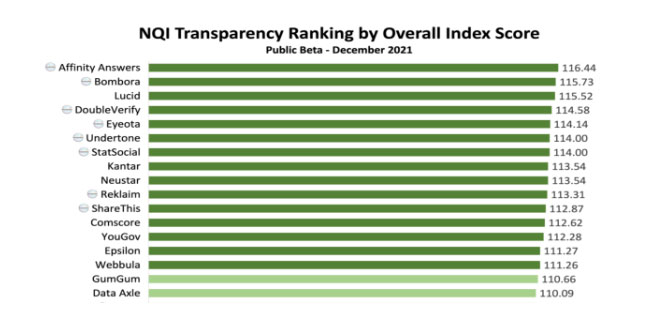
In Neutronian’s December 2021 NQI Transparency Ranking, Webbula ranked number 15 out of approximately 165 data providers, including Google and Facebook.
In Truthset’s quarterly Truthscore™ Index Report, Webbula consistently scores within the top three for the following audience segments:
- Presence of Children in Household
- Cat Owner
- Dog Owner
- Household Income:
- 100k or more
- $50k or less than $100k
- Home Owner
- Renter
- Car Manufacturer
- BMW
- Hyundai
- Kia
- Mazda
- Volve
- Subaru
- Relationship Status
- Married
- Race/Ethnicity
- African American
- Hispanic
- Education
- Overall
- Grad School
- Employment
- Currently Employed
- Small Business Owner
For more information about Webbula’s Audience Data, visit the Audience Data service page on our site. You can also view our full data taxonomy. To purchase our audience data segments from a partner, visit our programmatic solutions directory.